
War on a learning curve
When, a year ago, I spoke with Ukrainian veteran drone pilot Jack de Santis, he said that soldiers who leave the front for rehabiliation and return after eight or nine months, need full retraining because drone warfare changes that fast. Since then, Ukraine accelerated the pace of iteration to seven days. I was so struck by this number, that I asked the team to dig into it and prepare a detailed briefing for members:
DeepSeek shows us the future, again
When GPT-5.5 rolled out this week, OpenAI’s reasoning research lead Noam Brown, tweeted
with today’s AI models, intelligence is a function of inference compute. Comparing models by a single number hasn’t made sense since 2024. What matters is intelligence per token or per $.
With the compute crunch, doing more with less compute could be a winning strategy.
And it runs counter to the culture American AI labs enjoyed for the past few years. The mantra was “moarrr compute, better benchmarks.” Chinese labs, with less capital and minimal access to cutting-edge compute, didn’t have that luxury. So they adapted. In a nutshell, how much real-world capability can they afford to deploy per token, per user?
DeepSeek’s new V4 model is marginally worse than GPT-5.4 ( has an excellent technical breakdown of it), but it is 4x cheaper, reflecting, in part, lower compute costs. As inference costs approach 10% of total engineering headcount spend, that line item begins to matter.
argues further:
In China, compute is more than an expense line. It is a strategic constraint shaped by export controls, chip supply, cloud capacity, domestic hardware readiness, and inference economics. […] DeepSeek is turning compute scarcity into a set of design specifications.
I am on my way to Beijing and will be looking to understand exactly how this plays out on the ground.
A MESSAGE FROM OUR SPONSOR
The developer conference of the year. On demand on Salesforce+
Agentic AI is reshaping how software gets built, and Agentforce is out in front.
Catch the TDX sessions on Salesforce+ to see what this looks like in practice: deep dives on Agentforce, Data 360, the core Salesforce platform, vibe coding, Slack, and more – all available to stream for free.
By watching TDX on Salesforce+ you can:
See what’s coming next: Hear directly from the leaders defining the roadmap for AI-native development.
Go beyond the main stage: Access broadcast‑only segments and candid interviews you won’t find elsewhere.
Start with the main keynote to experience how software is being reinvented, then explore the full programme at your own pace.
Where humans matter most
In 2018, I argued that “automated perfection is going to be common… What is going to be scarce is human imperfection.” I returned to it a few months ago:
When I first wrote about artisanal cheese, I imagined this shift unfolding more slowly, alongside the automation of routine office work and putting more robots on assembly lines. I didn’t anticipate that, nine years later, I could build custom software in an hour or produce work that once required entire teams while walking through customs.
Economist wrote an excellent essay, a vivid case study of how automation reshapes where humans matter most. When the internet entered the economy, 60% of travel agents lost their jobs. The routine tasks of searching, comparing, reserving etc. moved from the agents’ computers to ours. What happened to the remaining 40%? It was hardly fighting over scraps; what we wanted from travel changed in tandem. And for the surviving two-fifths, it was more upmarket, higher-end, curated. As a result, travel agent salaries grew from 87% of the private‑sector wage average in 2000 to 99% by 2025.
I like ’s word for this destination – “the relational sector”. It’s work whose value is inseparable from the human providing it.
Solar overtakes nuclear
In 2025, the world’s solar panels generated nearly as much electricity as the world’s nuclear reactors. So far in 2026, Ember’s new data shows that solar is starting to overtake nuclear on a 12-month rolling basis.1 Nuclear is still vital, of course. Last year was its best year ever in absolute terms, but its share of global electricity has fallen from a 1996 peak of 17.5% to under 9%.
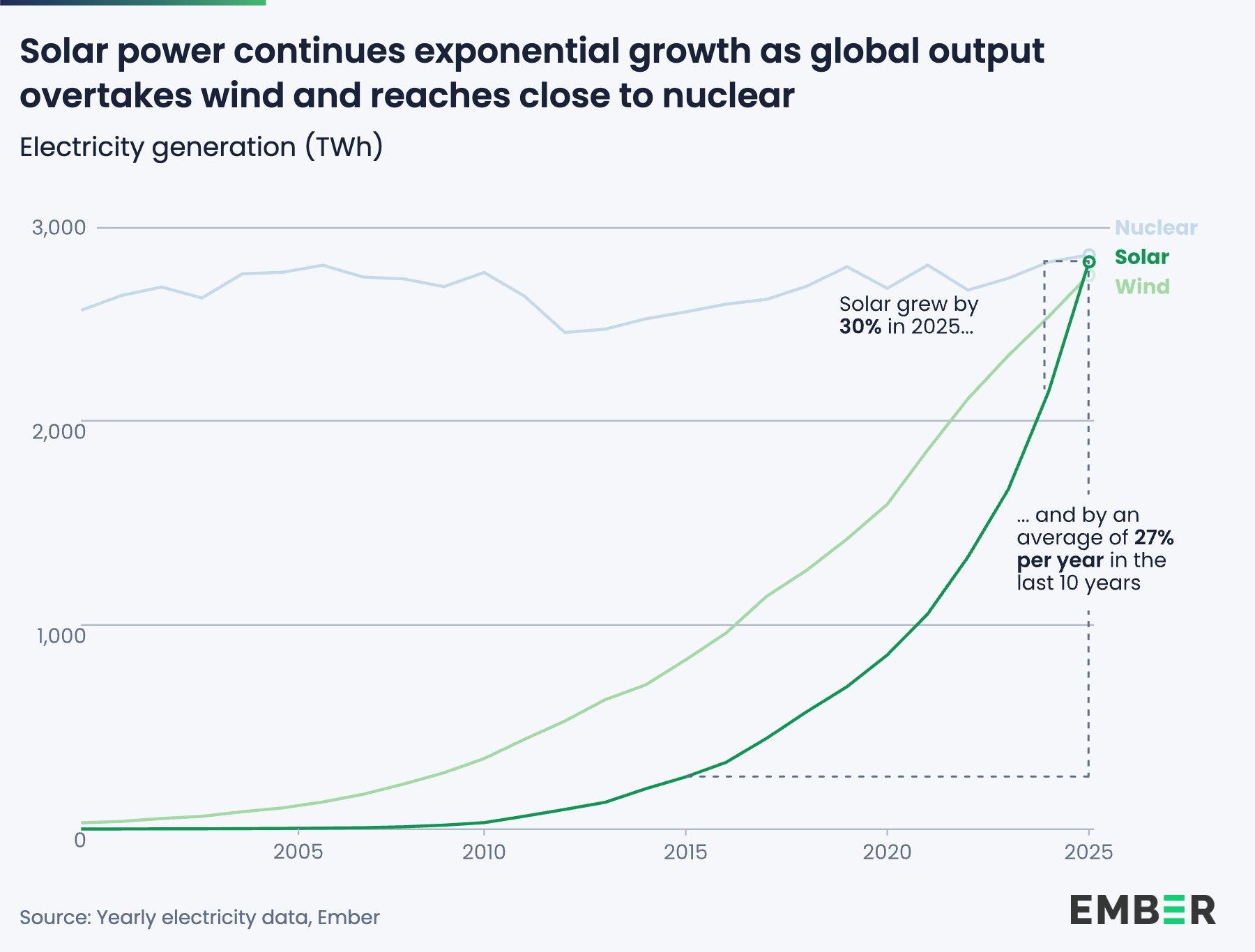
The main way we explain this is that energy is becoming a technology, not a commodity. Commodities get scarcer and pricier as you extract them. Technologies are on a learning curve, getting cheaper as you make more. Solar module prices have fallen over 90% since 2010, and in 2025, solar met three-quarters of all new electricity demand on the planet. As solar rides learning curves, new markets open and make possible what was previously impossible. We call this the solar supercycle.